
| Quick Answer: The secret to a quick divorce isn’t filing the paperwork faster; it is reaching an agreement sooner. In Illinois, the fastest legal route is an Uncontested Divorce, which can be finalized in as little as 60 to 90 days. However, this is only possible if you and your spouse sign a full Marital Settlement Agreement covering custody, support, and assets before you file. If you rely on the court to decide these issues (litigation), the process will take 18–24 months. To fast-track your freedom, focus on negotiation and conflict management, not courtroom battles. |
Introduction: Speed is a Mindset, Not Just a Filing Status
Everyone who walks into my office wants to rip the band-aid off.
They’ve spent weeks—sometimes months—building up the courage to say “I’m done.” Now they’re Googling how to get a quick divorce, hoping for some magic loophole that’ll have them signing papers by Friday.
I get it. The faster you can close this chapter, the faster you can start rebuilding.
But here’s the reality check nobody wants to hear: there is no “Express Lane” in family court unless you and your spouse agree on everything. The Cook County courthouse doesn’t have a VIP section for people who filed first or hired the fanciest attorney.
Here’s what I’ve learned after coaching hundreds of clients through divorce: the speed of your divorce isn’t determined by your lawyer’s typing speed.
It’s determined by your ability to manage conflict and reach a Marital Settlement Agreement.
That document—where you and your spouse decide custody, support, and assets together—is the only thing standing between you and freedom. Everything else is just paperwork.
 |  |
The “Uncontested” Myth: Why Filing First Doesn’t Mean Finishing First
Let’s talk about what an uncontested divorce actually means, because Google loves throwing this term around without context.
An uncontested divorce in Illinois means you and your spouse agree on:
- Child custody and parenting time
- Child support and spousal maintenance
- Division of assets and debts
You agree on all of this before the judge ever sees your case. You’ve done the hard work privately, and the court just rubber-stamps your agreement.
Sounds simple, right? Here’s the trap I see constantly.
Someone files for divorce aggressively to “get things moving.” But they haven’t agreed on who gets the house, who takes the kids on Christmas, or how they’re splitting the 401(k).
Congratulations—you just started a two-year lawsuit, not a three-month administrative process.
I watch this play out all the time. Someone files first because they think it gives them leverage. Maybe it does. But if your spouse is angry, caught off guard, or feels blindsided, you’ve just guaranteed they’ll fight you on everything out of principle.
That filing becomes the starting gun for a marathon of discovery requests, temporary orders hearings, and trial continuances. Court dates in Illinois are often scheduled three to six months apart.
Filing first doesn’t get you divorced faster. Getting your spouse to sign the Marital Settlement Agreement does.
The Real Bottleneck: Why “Winning” Slows You Down
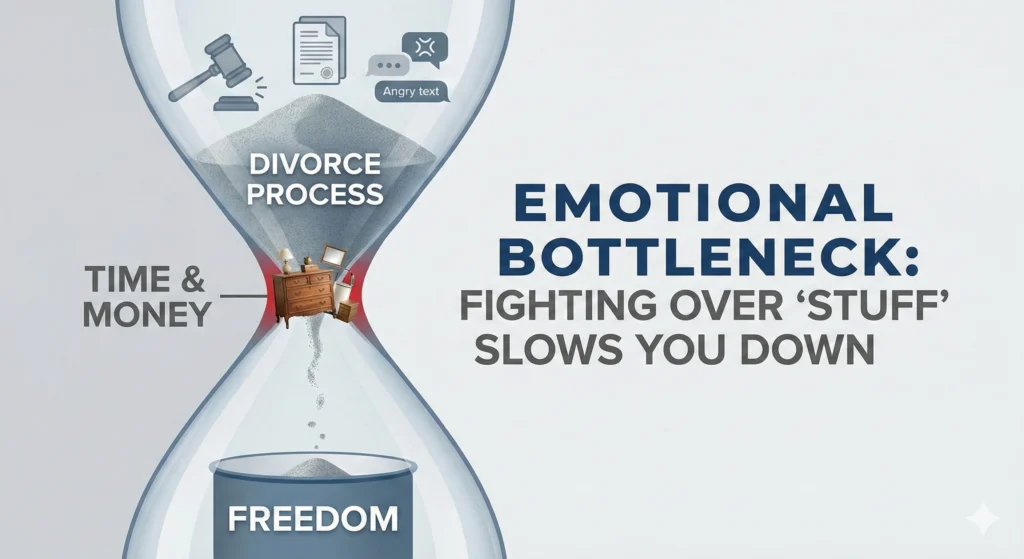
Here’s the psychology nobody talks about: fighting over every small item because you want the “moral victory” is the number one cause of delays.
I call this the Emotional Bottleneck.
You want the antique dresser your mother-in-law gave you because it’s the “right thing.” Your spouse wants it because giving it to you feels like admitting fault. So now we’re scheduling a hearing over a $400 piece of furniture.
This requires attorney preparation time, court filing fees, and a judge who honestly doesn’t care about your dresser.
Every fight—no matter how righteous it feels—requires emails, motions, and court dates. Each motion adds weeks. Each continuance adds months.
The cost of conflict isn’t just financial. It’s time you’ll never get back.
Here’s my coaching perspective, and I say this with compassion: If you want a quick divorce, you have to treat this like a business transaction, not a revenge plot.
Identify your non-negotiables. Prioritize what actually matters for your future. Let go of the rest so you can sign the papers and move on.
You can be right, or you can be done. You usually can’t be both.
3 Strategic Steps on How to Get a Quick Divorce
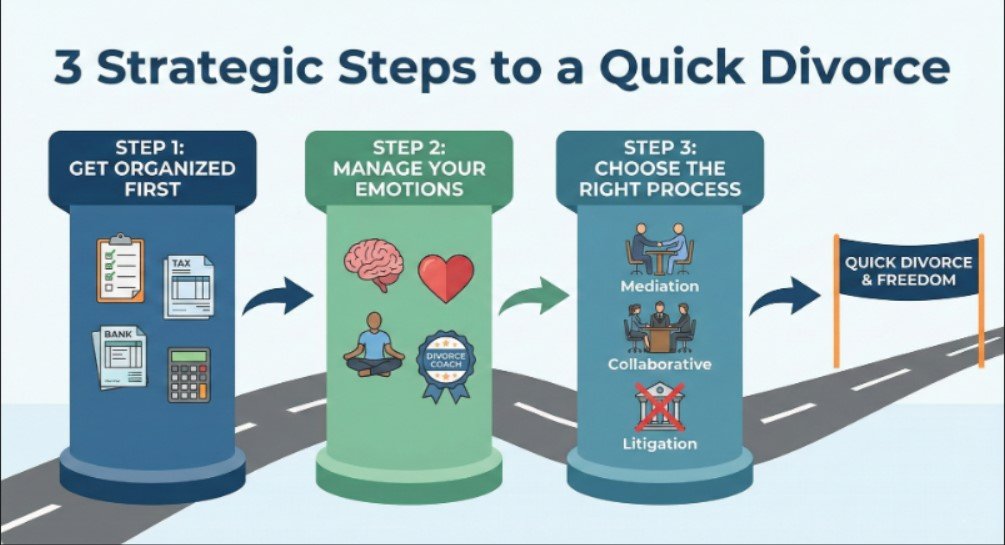
Step 1: Get Organized First
You cannot split the pie if you don’t know how big it is.
The fastest divorces I’ve seen happen when both parties show up to the first negotiation with complete financial documentation: bank statements, retirement account balances, mortgage statements, and tax returns.
Delays happen when one spouse claims they “don’t know” the accounts’ value, or when discovery reveals hidden assets months later. Judges don’t like surprises, and neither do mediators.
Action items:
- Gather three years of tax returns
- List all bank accounts, retirement accounts, and investment accounts with current balances
- Document all debts: mortgages, car loans, credit cards, student loans
- Create a household budget showing monthly expenses for yourself and the kids
This homework feels tedious. I know. But it’s the foundation. Without it, you’re guessing. And guessing leads to disputes.
Step 2: Manage Your Emotions (So You Can Negotiate)
This is where most people get stuck, and it’s exactly where a Certified Divorce Coach® becomes invaluable.
You cannot negotiate effectively when you’re drowning in rage, betrayal, or grief. Those emotions are valid—they’re just not strategic.
I help clients process the anger in our coaching sessions so they can sit at the mediation table and make rational decisions. We work through the “why” privately, so you don’t waste $400/hour of attorney time venting.
Illinois is a no-fault divorce state. The judge doesn’t care who cheated. The judge cares about equitable division and the best interests of the children. If you spend six months litigating moral blame, you’ve spent six months not getting divorced.
Step 3: Choose the Right Process
Not all divorce processes are created equal when speed is your priority. Let’s break down your options:
- Litigation: This is the traditional courtroom battle. It is inherently slow because you’re operating on the court’s schedule. The average timeline in Illinois is 18 to 24 months.
- Mediation: You meet with a neutral third party to negotiate the agreement. You control the timeline. The average timeline is usually 3 to 6 months if both parties negotiate in good faith.
- Collaborative Divorce: Similar to mediation, but includes a team of professionals. Everyone signs an agreement not to go to court. Average timeline runs 6 to 12 months.
If your goal is how to get a quick divorce, mediation is usually your best bet—but only if both parties are committed to reaching an agreement.
How a Divorce Coach Speed-Tracks the Process
Here’s the return on investment nobody talks about: I help you reach that Marital Settlement Agreement faster.
Most people come to me stuck in the weeds. They’re fighting over the holiday schedule, the wedding china, or frequent flyer miles.
I help them zoom out and ask: “What do you need to feel financially secure and emotionally whole in five years?”
Usually, the answer isn’t the china.
When we clarify your priorities—maybe it’s keeping the house until the kids graduate, or preserving your retirement accounts—the smaller stuff becomes easier to compromise on. You stop wasting negotiation capital on battles that don’t move you toward your goals.
I’ve watched clients finalize their divorces months faster because we identified the emotional bottlenecks and cleared the path to agreement.
That’s the real shortcut: emotional efficiency.
Frequently Asked Questions
How long does an uncontested divorce take in Illinois?
If you have a signed Marital Settlement Agreement, an uncontested divorce can be finalized in as little as 60 to 90 days from filing. However, Illinois requires a statutory waiting period unless you have been separated for six months or both agree to waive it.
Can we get divorced without a lawyer to save time?
Technically, yes. Illinois allows for “pro se” divorce. However, this only makes sense for very simple cases (short marriage, no kids, no assets). Even then, I strongly recommend consulting an attorney to review your settlement. Mistakes in the agreement can haunt you for years.
What if my spouse refuses to sign the agreement?
If your spouse refuses to negotiate, you will need to proceed with a contested divorce (litigation). If they completely disappear or refuse to respond, you can request a default judgment, typically 30 to 60 days after the deadline to respond passes.
Does hiring an expensive attorney speed up the process?
Not necessarily. A “bulldog” litigator who files aggressive motions often escalates conflict and slows everything down. The best attorney for a quick divorce is one who shares your goal of settlement and has strong negotiation skills.
Will proving my spouse had an affair help me get divorced faster?
No. Illinois is a no-fault divorce state. Proving infidelity rarely affects the legal outcome and definitely doesn’t speed up the process. In fact, litigating fault often slows things down by adding unnecessary conflict. (For more on this, see our article on how affairs affect divorce proceedings.)
Should I consider divorce mediation to save time?
Absolutely. If both parties are willing to negotiate in good faith, mediation is one of the fastest paths to finalization. (Learn more about working with key professionals like mediators in our guide to the 5 essential divorce professionals.)
Conclusion: You Can Be Right, or You Can Be Divorced
Here’s the bottom line: speed in divorce requires strategy, not aggression. It requires emotional discipline, not courtroom theatrics.
It requires you to make peace with the fact that getting divorced quickly means letting go of the need to be validated by a judge who’s already juggling 50 other cases.
The clients who finalize fastest aren’t the ones with the best attorneys. They’re the ones who do the emotional work, prioritize their future, and sign the agreement even when it’s not perfect.
If you’re serious about learning how to get a quick divorce, you need to shift your focus from winning to finishing. That’s where I come in.
Don’t let emotions drag this out for years. Join my Smart Start program to build the strategy that gets you to the finish line fast.
We’ll cut through the emotional bottlenecks, clarify your priorities, and create a roadmap that turns months of chaos into weeks of focused action.
Because you deserve to move forward, and moving forward starts with a plan.
💡 Coach’s Corner: What is an Uncontested Divorce? An uncontested divorce means both spouses agree on all major issues—child custody, support, and property—before appearing in court. The judge simply reviews and approves the agreement you’ve already negotiated. This is the fastest, least expensive path. The keyword? Agreement. Without it, you’re in contested territory, and the timeline expands significantly.
Katie VandenBerg is a CDC Certified Divorce Coach® specializing in high-conflict co-parenting and strategic divorce planning in Central Illinois. She helps women build efficient, effective divorce teams that protect their finances and their peace, as seen in her client success stories.