

By Katie Vandenberg, CDC Certified Divorce Coach®
Quick Answer: Can I Divorce If He Refuses? Yes. Illinois is a “No-Fault” divorce state, meaning you do not need your spouse’s permission to end the marriage. If you state that the marriage is irretrievably broken, he cannot veto your decision. If he refuses to sign papers or appear in court, you can obtain a Default Judgment, which allows the divorce to proceed—often with terms favorable to you—without his participation.
Introduction: The “Bad Guy” Burden
“I want a divorce but my husband doesn’t, and he won’t sign the papers.” “He says he loves me and refuses to break up the family.” “I feel like a monster for hurting him.”
If you are reading this, you are likely carrying a crushing weight of guilt. You have agonizingly arrived at the decision to end your marriage, but your husband is either in denial, begging for “one more chance,” or flat-out refusing to participate.
Here is the hard truth you need to hear right now: A marriage takes two people to sustain, but only one to end.
As a Divorce Coach, I see brilliant, capable women stay stuck in unhappy marriages for months simply because they are waiting for their husband to agree with them. They are waiting for permission. They are waiting for him to say, “Okay, I understand.”
He is never going to say that. And the good news is: You do not need him to.
Divorce is not a debate where you have to win his vote. It is a unilateral decision to restructure your life. You are not asking for permission; you are notifying him of a change.
The Legal Reality: Why You Don’t Need His Permission in Illinois

The competitor blogs will tell you how “perilous” and “expensive” it is to divorce a reluctant spouse. They want to scare you. I want to empower you with the facts about Illinois law.
The “No-Fault” Advantage
Illinois is a strictly “No-Fault” divorce state.
- What this means: You do not need to prove he cheated, abused you, or abandoned you.
- The Standard: You only need to state that “irreconcilable differences have caused the irretrievable breakdown of the marriage.”
- The Reality: If you say the marriage is broken and he says it isn’t, the court will almost always side with the person who says it is broken. He cannot veto your divorce.
The Myth of the “Signature”
“But what if he refuses to sign the papers?”
This is the biggest myth in divorce. If your husband refuses to hire a lawyer, ignores the court summons, or refuses to negotiate, he cannot stop the divorce. He can only slow it down.
If he ignores the legal deadlines (usually 30 days after being served), your lawyer can file for a Default Judgment.
- What is a Default Judgment? It means the judge grants the divorce without his participation.
- The Risk for Him: If he doesn’t show up to argue his side, the judge often grants exactly what you asked for regarding the house, the kids, and the assets.
Coach’s Corner: The “Refusal” Script
Him: “I’m not signing anything. You can’t leave me.”
You: “I understand you are hurt, and I am not doing this to punish you. But I am moving forward with or without your participation. It will be much cheaper and less painful for both of us if we work together, but the divorce is happening regardless.”
The Psychology of Stalling: Is it Denial or Manipulation?
When a husband refuses to engage, it usually falls into one of two categories: The “Ostrich” or The “Controller.” Knowing which one you are dealing with is critical for your strategy.
1. The “Ostrich” (Denial)
He pretends everything is normal. He asks what’s for dinner even though you served him papers yesterday. He believes if he ignores it, it will go away.
- Your Strategy: You must be the engine. You set the deadlines. You move the process. You cannot wait for him to “catch up.”
2. The “Controller” (Manipulation)
This is darker. He uses guilt (“You’re destroying the family”), love bombing (“I’ll change! I’ll go to therapy!”), or threats (“I’ll take the kids”) to keep you frozen.
- Your Strategy: Do not pause the legal process based on a promise. If he is truly changing, he can do that while living separately. Do not let “hope” become a stalling tactic.
Reality Check: If the only thing that sparked his sudden willingness to change was the threat of you leaving, that is not transformation—that is panic.
The “Solo Project Manager” Mindset (Crucial Shift)
This is the hardest pill to swallow, but it is necessary: Assume you will be doing 100% of the work.
If he doesn’t want the divorce, he certainly won’t help you organize it. You cannot expect him to gather tax returns, research mediators, or schedule house appraisals.
- Stop waiting for him to “help.” He won’t.
- Stop asking him to “collaborate.” He can’t.
You must adopt the mindset of a Project Manager. You are the CEO of this dissolution. It is unfair that you have to do all the work to leave a relationship that failed you, but accepting this burden now will save you months of frustration later.
Coach’s Corner: Do not view his laziness as a reason to stop. View it as a reason to lead. The person who does the work controls the timeline.
Protecting the Children from His Denial
If your husband is in denial, he may also be confusing the children. He might tell them, “Mom is just having a moment,” or worse, “Mom is trying to break up our family.”
How to handle this:
- Get Them Support: Just as you need a team, they might need one too. Consider a child therapist or school counselor early—before the conflict peaks.
- Stick to the Script: “Mom and Dad are having some grown-up problems. We both love you, and that will never change.”
- Don’t Force Him to “Perform”: If he refuses to tell the kids with you, you may have to do it alone (or with a therapist). Do not delay telling them just because he refuses to show up to the family meeting.
Tactical Steps: How to Move Forward When He Refuses to Engage
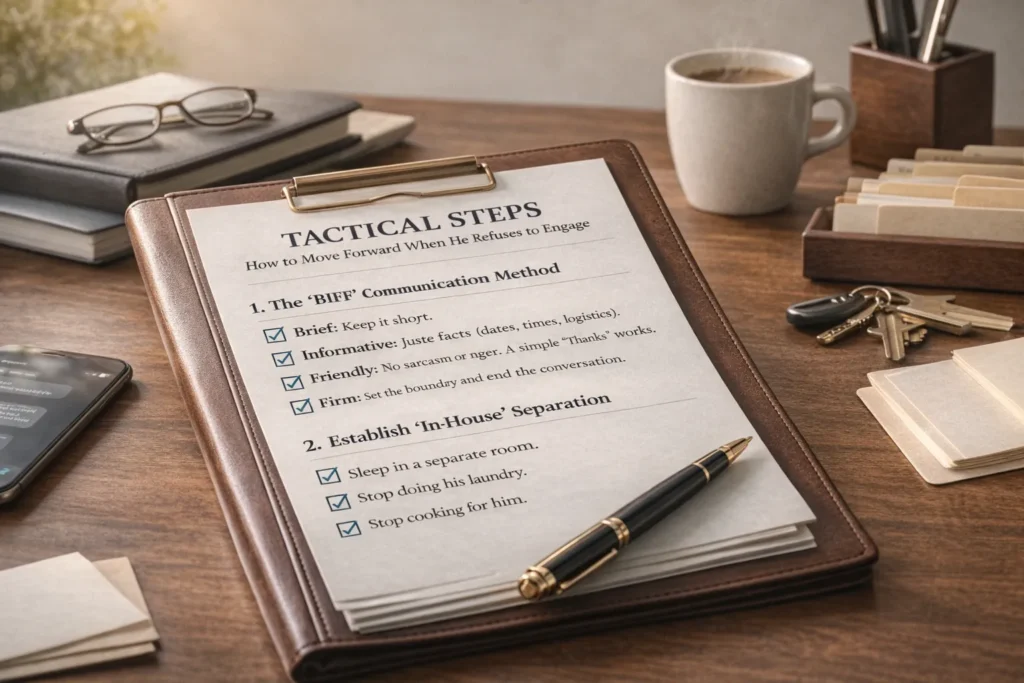
You have filed, but he is stalling. Here is your Focused Forward game plan.
1. The “BIFF” Communication Method
Stop having long, emotional arguments in the kitchen. Switch to the BIFF method for all texts and emails:
- Brief: Keep it short.
- Informative: Just the facts (dates, times, logistics).
- Friendly: No sarcasm or anger. A simple “Thanks” works.
- Firm: Set the boundary and end the conversation.
2. Establish “In-House” Separation
If he refuses to move out (and in Illinois, you generally cannot force him out unless there is abuse), you must create separation under the same roof.
- Sleep in a separate room.
- Stop doing his laundry.
- Stop cooking for him.
- Why? This signals to him (and the court) that the marriage is functionally over.
Financial Protection: The Pre-Divorce Checklist
The moment you know divorce is coming, you need to get smart about money—especially if he is the “finance guy” in the relationship. Do not wait for “Discovery” to start gathering info.
Immediate Financial Steps:
- Gather Documents: Secure copies of the last 3 years of tax returns, bank statements, and retirement accounts. Save them to a cloud drive he cannot access.
- Pull Your Credit Report: Check for joint debts or accounts you didn’t know about.
- Open Your Own Account: Start depositing your paycheck into an account in your name only.
- Freeze Joint Credit: If you fear he will run up debt to punish you, contact credit card companies to freeze joint accounts (Consult your attorney first).
- Document Spending: If he pays the mortgage and bills, document that history. This establishes the “status quo” for temporary support hearings.
Coach’s Corner: Financial ignorance is not a defense. You need to know exactly what you own and what you owe before you sit down at the negotiation table.
Why You Need a Strategy Partner (Not Just a Lawyer)
A lawyer handles the legal paperwork. They file the motions and argue the statutes.
A Divorce Coach handles the reality.
- I help you write the email to him that is firm but not inflammatory.
- I help you stay calm when he is gaslighting you in the kitchen.
- I help you stop feeling guilty for choosing your own happiness.
When you are dealing with a resistant spouse, your legal bills can explode because every email becomes a fight. My job is to help you manage your emotions so you can manage the business of your divorce efficiently.
Frequently Asked Questions
Can I divorce my husband if he doesn’t want to?
Yes. Illinois is a “No-Fault” state. You do not need his permission or his signature to start the process. If he refuses to participate, the court can eventually grant a divorce by default. You cannot be forced to stay married against your will.
Who loses most in a divorce?
Financially, women often see a larger drop in household income post-divorce (roughly 41%). However, the person who “loses most” is usually the one who is unprepared. This is why having a financial and strategic plan before you file is critical to preserving your assets.
What are the four signs a marriage will end in divorce?
Renowned researcher Dr. John Gottman identified “The Four Horsemen” that predict divorce with over 90% accuracy:
Criticism: Attacking your partner’s character.
Contempt: Mocking or hostile humor (the #1 predictor).
Defensiveness: Blaming the partner instead of taking responsibility.
Stonewalling: Shutting down and refusing to communicate.
How to divorce if husband refuses?
If he refuses to negotiate, you must stop waiting for him.
File the Petition for Dissolution.
Serve him formally.
If he ignores the 30-day response window, your lawyer files for a Default Judgment.
The judge grants the divorce based on your terms.
Conclusion: Stop Waiting for Permission
You have spent enough time feeling guilty. You have spent enough time waiting for him to “get it.”
He doesn’t have to agree with your decision for it to be the right decision.
If you are ready to stop walking on eggshells and start building your exit strategy, you need a partner who understands the high-conflict dynamics of a resistant spouse.
Let’s get you Focused Forward.
Click here to book your “Smart Start” Strategy Session today.
For more insights on navigating complex relationships, check out our Divorce Support Blog.
This video from Katie Vandenberg shares more about her background and coaching philosophy: Focused Forward with Katie VandenBerg
I selected this video because it directly features Katie Vandenberg explaining her background and approach to “Focused Forward,” which builds trust and reinforces the personal connection established in the blog post.
Katie VandenBerg is a CDC Certified Divorce Coach® specializing in high-conflict co-parenting and strategic divorce planning in Central Illinois. She helps women build efficient, effective divorce teams that protect their finances and their peace, as seen in her client success stories.